

Your kitchen can look clean and still need a deep cleaning.
The counters may be wiped down. The dishes are put away. The floor was swept after dinner. At first glance, everything may seem perfectly fine.
But kitchens collect a different kind of buildup than most rooms in the house.
Cooking grease settles on cabinets. Crumbs disappear beneath appliances. Food splatter reaches the backsplash. Handles and switches are touched constantly. Water spots build around the sink. Dust combines with cooking residue in areas that rarely make it onto the weekly cleaning list.
That is why kitchens often need detailed cleaning more frequently than homeowners expect.
For busy Charlotte-area households, that does not mean deep cleaning the entire kitchen every weekend. It means recognizing when regular maintenance is no longer reaching the buildup that is quietly accumulating underneath.
Here is what to look for.
Why Kitchen Buildup Happens So Quickly
Think about how much activity happens in your kitchen during a normal week.
Breakfast is prepared before work or school. Lunches are packed. Coffee is made. Groceries come in. Dinner gets cooked. Snacks appear throughout the day. Family members open the refrigerator, touch cabinet pulls, use the faucet, run the microwave, and move through the room constantly.
Even households that cook only a few times each week still generate residue.
The challenge is that kitchen buildup often develops gradually.
A thin film begins forming on the cabinet beside the stove. The backsplash becomes slightly tacky. Crumbs collect along cabinet edges. The faucet starts looking cloudy. The top of the refrigerator gathers dust.
Because every change is small, it is easy to stop noticing it.
Then one day, you wipe a cabinet door and realize how much cleaner one section looks compared with the rest.
That is usually a sign that routine cleaning has been handling the visible mess while deeper buildup has continued underneath.
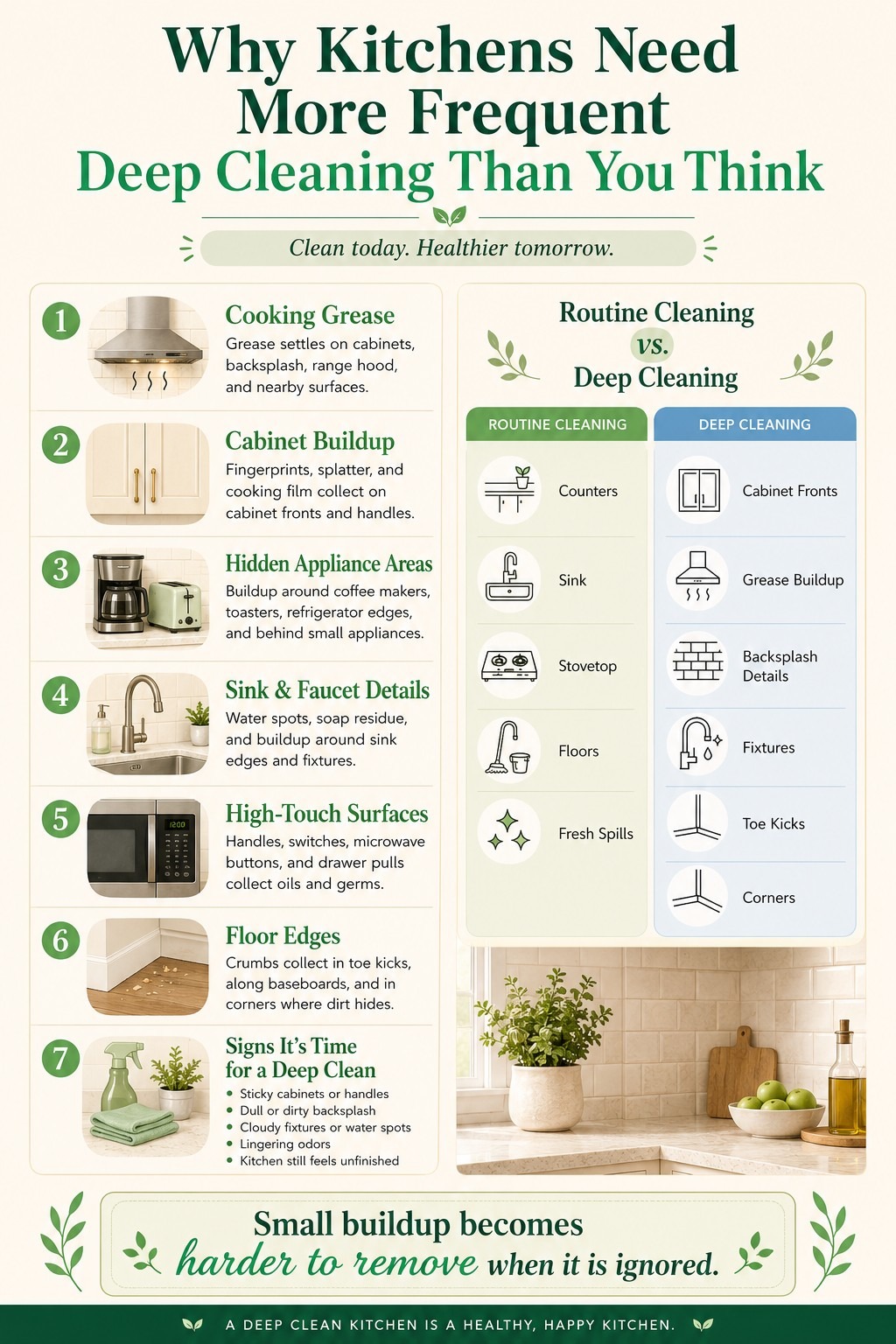
1. Cooking Grease Travels Farther Than the Stove
Grease does not stay neatly inside a frying pan.
Tiny particles from cooking can settle onto the stovetop, backsplash, nearby cabinets, range hood, appliance fronts, walls, and surrounding surfaces.
Over time, that residue can create the slightly sticky feeling many homeowners notice around heavily used cooking areas.
Once dust settles onto that film, the kitchen can begin looking dull even after the counters and floors have been cleaned.
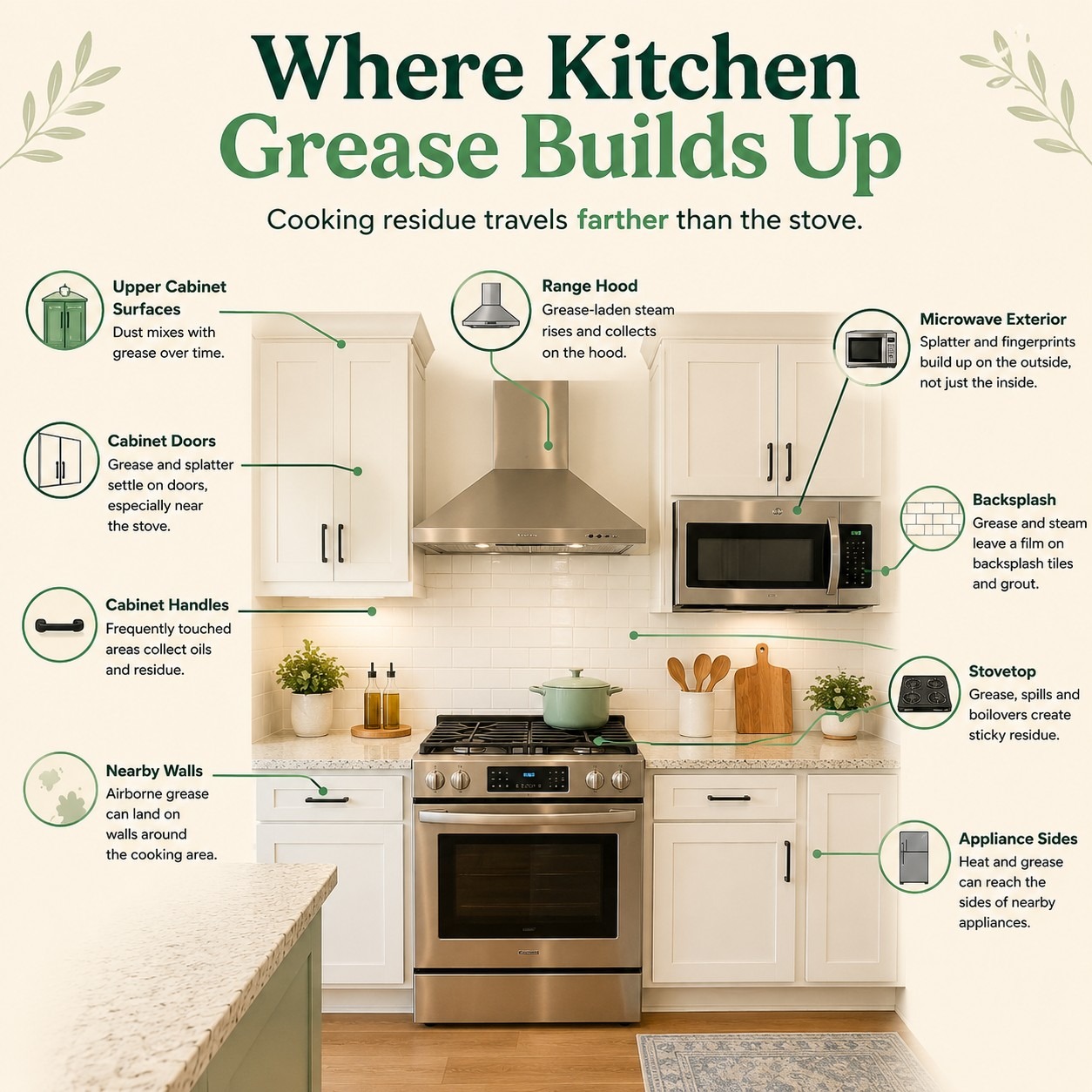
Areas worth checking include:
- Cabinet doors beside and above the stove
- Cabinet handles and pulls
- Range hood exterior
- Backsplash
- Microwave exterior
- Oven controls
- Nearby walls
- Appliance sides
- Upper cabinet surfaces
These areas may not need detailed scrubbing every week, but waiting too long can make the eventual cleanup much harder.
2. Cabinets Quietly Collect More Grime Than You Think
Kitchen cabinets are easy to overlook because they rarely look obviously dirty from across the room.
Look more closely around the handles, though, and you may notice fingerprints, cooking film, food residue, dust, and small splashes that have accumulated over time.
Lower cabinets can collect another layer of mess from shoes, pets, spills, sweeping, vacuuming, and everyday traffic.
Cabinets near the stove typically need more attention than cabinets farther away from the cooking area.
A quick spot wipe can take care of fresh marks.
But when several cabinet fronts begin looking dull, sticky, or noticeably different after one section is cleaned, the kitchen may be ready for a more thorough reset.
3. The Spaces Around Appliances Are Easy to Miss
Most weekly kitchen routines focus on the surfaces you can easily see.
That means hidden edges around appliances can go untouched for weeks or months.
Check areas such as:
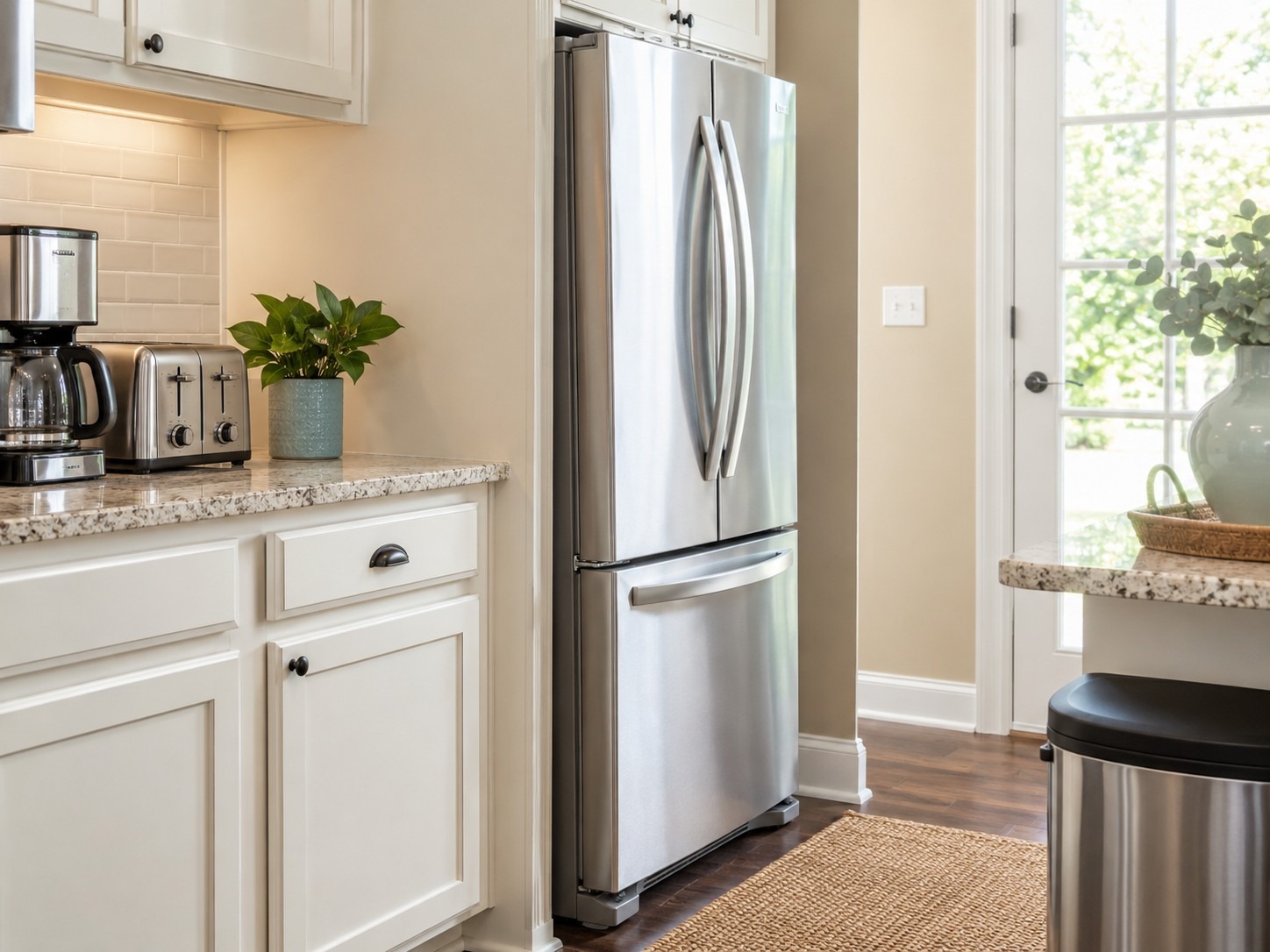
- Along the refrigerator
- Beneath small countertop appliances
- Around the toaster or coffee maker
- Along oven edges
- Under movable countertop items
- Behind trash cans
- Around appliance handles
- Along refrigerator seals
You do not need to pull every major appliance out constantly.
But periodically moving smaller items and cleaning the areas immediately around appliances helps prevent crumbs, grease, dust, and sticky residue from quietly becoming part of the kitchen.
4. The Sink Area Builds Up Fast
Your sink is one of the hardest-working areas in the kitchen.
Food preparation, rinsing dishes, washing hands, filling water bottles, cleaning cookware, and everyday spills all happen there.
Even when the sink itself gets rinsed every day, buildup can remain around:
- Faucet bases
- Handles
- Drain areas
- Sink edges
- Backsplash seams
- Soap dispensers
- Countertop corners
If your faucet looks cloudy shortly after you clean it or the area around the sink never seems fully refreshed, it may need more detailed attention rather than another quick wipe.
5. High-Touch Surfaces Need More Attention
Some of the busiest parts of your kitchen are also the smallest.
Think about how many times someone touches these surfaces every day:
- Refrigerator handles
- Cabinet pulls
- Microwave buttons
- Oven controls
- Faucet handles
- Pantry doors
- Light switches
- Drawer pulls
- Trash can lids
They are easy to miss because each area takes only seconds to clean.
The problem is remembering all of them.
A kitchen deep cleaning creates an opportunity to work systematically instead of cleaning only whatever looks dirty first.
6. Floors Tell Only Part of the Story
Kitchen floors usually receive more attention than most deep-cleaning areas because crumbs are easy to see.
Sweeping, vacuuming, and mopping regularly are important, but the middle of the floor is rarely where buildup becomes most noticeable.
Look along:
- Baseboards
- Cabinet toe kicks
- Corners
- Under cabinet edges
- Around trash cans
- Beneath movable furniture
- Around the refrigerator and stove
Those edges can make an otherwise clean kitchen feel unfinished.
They are also exactly the type of details that tend to get skipped when you are trying to finish cleaning quickly.
Standard Kitchen Cleaning vs. Kitchen Deep Cleaning
Routine cleaning and deep cleaning serve different purposes.
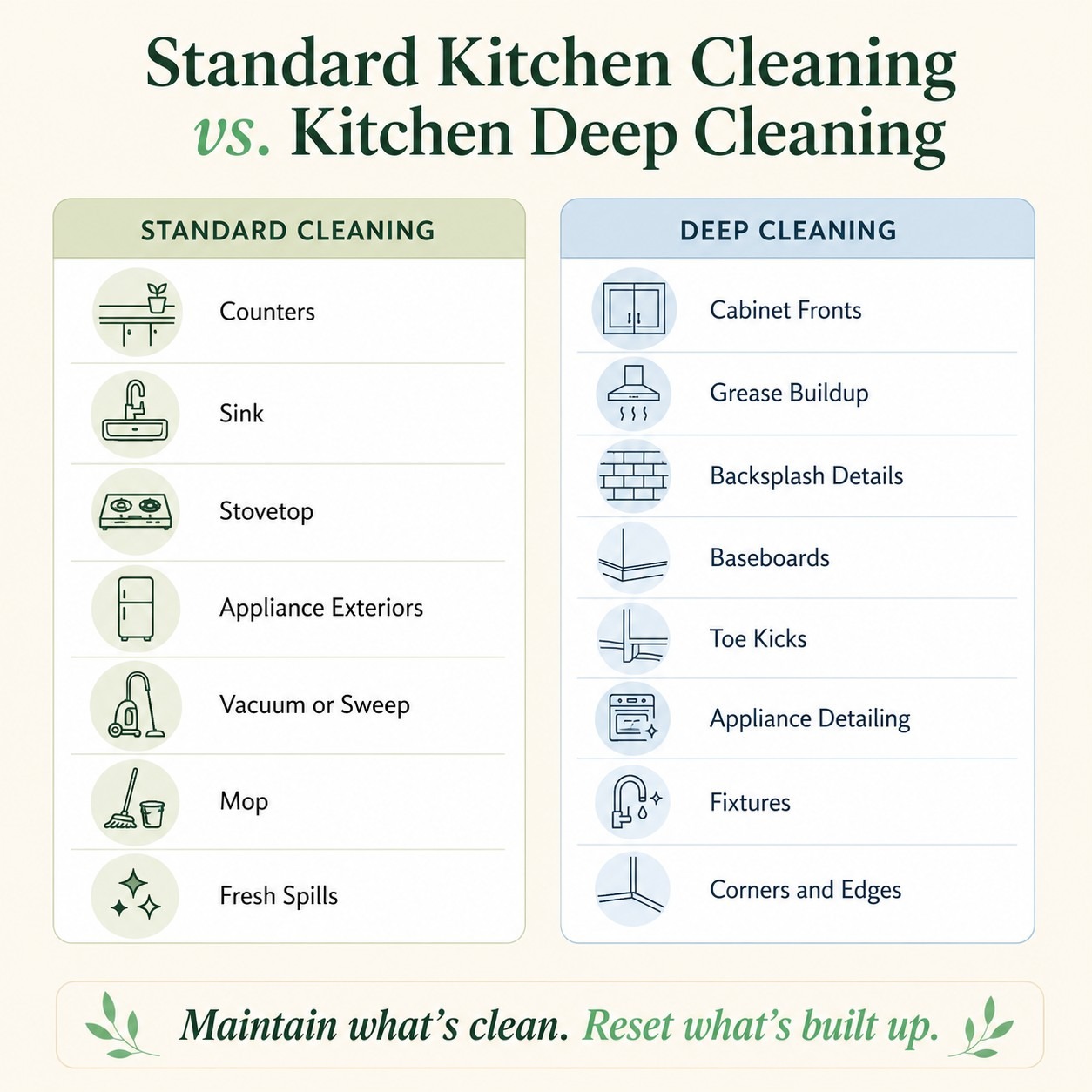
Standard kitchen cleaning focuses on everyday maintenance.
That may include:
- Wiping counters
- Cleaning the sink
- Wiping appliance exteriors
- Cleaning the stovetop
- Vacuuming or sweeping
- Mopping
- Removing obvious fingerprints
- Taking care of fresh spills
Kitchen deep cleaning focuses on accumulated detail.
Depending on the service and the condition of the kitchen, that can mean spending more time on areas such as:
- Cabinet fronts
- Backsplash details
- Grease buildup
- Baseboards and toe kicks
- Appliance detailing
- Handles and fixtures
- Corners and edges
- Hard-to-reach surfaces
- Areas that have not been thoroughly cleaned in some time
The easiest way to think about it is this:
Standard cleaning maintains a kitchen that is already under control. Deep cleaning helps reset a kitchen when buildup has started taking over.
How Often Does a Kitchen Really Need Deep Cleaning?
There is no single schedule that works for every household.
A lightly used kitchen in a one-person home will accumulate buildup very differently from a kitchen serving a busy family several meals every day.
Instead of following the calendar alone, look at how the kitchen is actually being used.
You may benefit from more frequent kitchen deep cleaning if:
- Your household cooks most days
- You frequently fry, sauté, or cook with oils
- You have children
- You have pets
- The kitchen is a major gathering area
- Cabinet fronts get dirty quickly
- Grease repeatedly builds around the stove
- You notice odors even after routine cleaning
- Baseboards and corners rarely get cleaned
- Your kitchen has not had a detailed reset in several months
The busier the kitchen, the faster small maintenance gaps can add up.
Signs Your Kitchen Is Ready for a Deep Clean
You do not have to wait until the kitchen looks terrible.
In fact, deep cleaning is much easier when you catch buildup before it becomes severe.
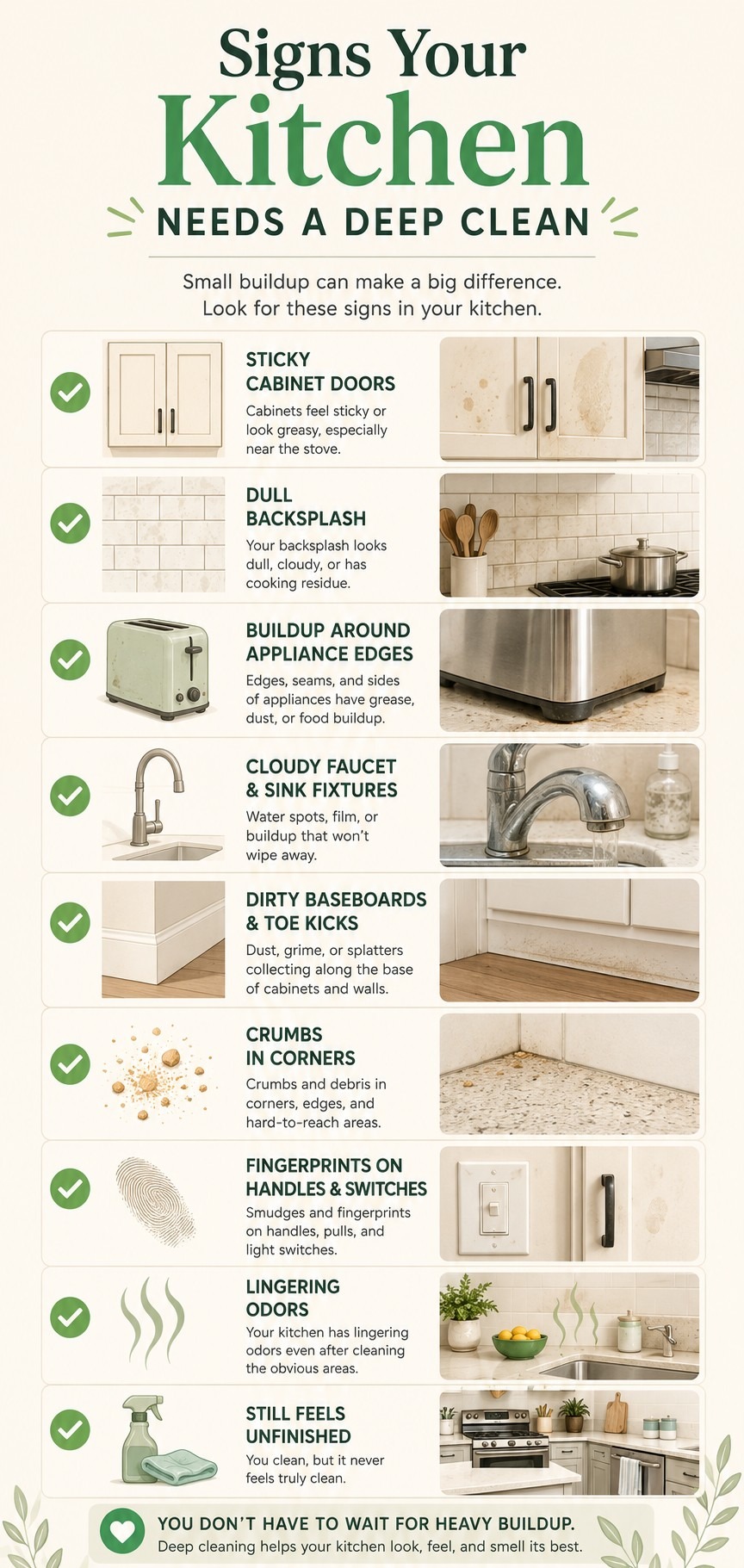
Consider a kitchen reset when you notice several of these signs.
Cabinet doors feel sticky
Especially around the stove, this can indicate accumulated cooking residue.
The backsplash still looks dull after wiping
A quick surface wipe may no longer be enough.
Appliances have fingerprints and residue around the edges
Handles may be getting cleaned while the surrounding details are being missed.
The sink and faucet never seem completely polished
Water spots and residue may need more detailed attention.
Baseboards and toe kicks look noticeably darker
These areas collect dust, crumbs, and everyday kitchen traffic.
The kitchen smells less fresh than it looks
Check trash areas, the sink zone, appliance surroundings, and overlooked corners.
You keep cleaning but the kitchen still feels unfinished
This is one of the clearest signs.
Sometimes the problem is not that you need to clean more often.
You simply need to clean deeper.
A Simple Way to Keep Kitchen Deep Cleaning From Becoming Overwhelming
You do not have to tackle every detail at once.
Between deeper resets, rotate one detailed kitchen task into your normal routine.
For example:
Week 1: Wipe cabinet fronts and handles.
Week 2: Detail the backsplash and cooking area.
Week 3: Clean around countertop appliances.
Week 4: Focus on baseboards, toe kicks, and floor edges.
Small maintenance sessions help slow down buildup.
Then, when the kitchen eventually needs a full deep cleaning, you are starting from a much more manageable place.
Busy Families Usually Notice the Difference First
For families juggling work, school, pets, activities, errands, and meals, the kitchen can feel like it resets itself every few hours.
You clean after breakfast.
Someone prepares lunch.
You wipe the counter again.
Dinner happens.
The sink fills back up.
By bedtime, it can feel like the kitchen never stayed clean at all.
That does not necessarily mean you need to spend more time cleaning.
It means you are maintaining one of the most heavily used rooms in your home.
Routine cleaning keeps daily mess manageable.
Periodic deep cleaning handles the residue and details that regular maintenance cannot always keep up with.
Together, those two layers make maintaining the kitchen much easier.
When Professional Kitchen Deep Cleaning Makes Sense
Sometimes you have the time and energy to handle the reset yourself.
Sometimes you would rather spend your weekend doing almost anything else.
Professional kitchen deep cleaning can be especially helpful when:
- Buildup has accumulated over several months
- You are preparing to host guests
- You are returning to recurring cleaning
- Your household has gone through an unusually busy season
- Cooking grease has spread across several surfaces
- Detailed kitchen cleaning keeps getting pushed to the bottom of your list
- You want to reset the kitchen before maintaining it regularly
A professional deep clean is not a replacement for normal kitchen maintenance.
Think of it as a reset point.
Once the accumulated detail is handled, keeping the room fresh becomes much easier.
Kitchen Deep Cleaning for Charlotte-Area Homes
My Clean Charlotte Maids helps busy homeowners take care of the detailed cleaning that is easy to postpone.
We proudly serve homes throughout Charlotte, Fort Mill, Rock Hill, Pineville, Matthews, Huntersville, Concord, Gastonia, Mooresville, Fayetteville, and Pinehurst.
Whether your kitchen needs a detailed reset after months of buildup or your entire home could use a stronger refresh, professional cleaning can help make your home feel easier to maintain.
Frequently Asked Questions About Kitchen Deep Cleaning
How often should you deep clean your kitchen?
There is no one-size-fits-all schedule, but many kitchens benefit from more detailed cleaning every few months. Homes that cook frequently, have children or pets, or experience heavy daily kitchen traffic may need deeper cleaning more often.
The best indicator is buildup. If cabinet fronts feel sticky, grease is collecting near the stove, baseboards look dingy, or the kitchen still feels unfinished after regular cleaning, it may be time for a deeper reset.
Why does my kitchen get dirty so quickly even when I clean every day?
Kitchens collect several types of buildup at once, including cooking grease, crumbs, food splatter, dust, fingerprints, water spots, and residue around appliances.
Daily cleaning usually takes care of fresh messes and visible surfaces. It may not reach cabinet edges, appliance sides, backsplash details, baseboards, toe kicks, and other areas where buildup develops gradually.
What is the difference between regular kitchen cleaning and deep cleaning?
Regular kitchen cleaning focuses on maintaining everyday surfaces such as countertops, sinks, stovetops, appliance exteriors, and floors.
Deep cleaning goes further by focusing on accumulated buildup and detailed areas that may not receive attention during routine upkeep. This can include cabinet fronts, grease-prone areas, baseboards, toe kicks, backsplash details, fixtures, appliance edges, and hard-to-reach corners.
Does my kitchen need a deep cleaning if it already looks clean?
Possibly.
A kitchen can look clean from across the room while still having buildup on cabinets, around the stove, behind countertop items, along floor edges, or around frequently touched surfaces.
If the kitchen looks presentable but still feels slightly sticky, dull, or difficult to keep fresh, deeper cleaning may help.
What are the biggest signs that my kitchen needs a deep clean?
Common signs include:
- Sticky or dull cabinet fronts
- Grease around the stove or backsplash
- Grime around appliance edges
- Dirty baseboards or cabinet toe kicks
- Cloudy faucets and sink fixtures
- Crumbs collecting in corners
- Fingerprints around handles and switches
- Lingering odors after routine cleaning
- A kitchen that still feels unfinished after you clean
You do not have to wait for severe buildup before scheduling a deeper cleaning.
Why does grease keep coming back on my kitchen cabinets?
Cooking grease can become airborne in tiny particles and settle on nearby surfaces, particularly cabinets around the stove.
Once dust attaches to that residue, the surface can become dull or slightly sticky. Regularly wiping high-grease areas can help, but established buildup may require more detailed cleaning.
Which kitchen areas are most commonly missed during regular cleaning?
Some of the easiest areas to overlook include cabinet fronts, cabinet handles, baseboards, toe kicks, appliance sides, backsplash corners, faucet bases, light switches, areas beneath countertop appliances, and the space around trash cans.
These details may seem small individually, but together they can make a kitchen feel much less clean.
Should I deep clean my kitchen before starting recurring house cleaning?
If your kitchen already has noticeable grease, grime, or detailed buildup, starting with a deep cleaning can be a good approach.
A deeper reset helps address existing buildup first. Recurring cleaning can then focus on maintaining the home and preventing everyday mess from becoming overwhelming again.
Can I maintain my kitchen between professional deep cleanings?
Yes.
Wipe fresh cooking splatter quickly, clean cabinet handles regularly, rotate one detailed task into your weekly routine, keep floor edges from accumulating crumbs, and periodically clean beneath movable countertop items.
Small maintenance habits can help extend the fresh feeling after a professional deep cleaning.
Does My Clean Charlotte Maids offer kitchen deep cleaning?
My Clean Charlotte Maids provides professional residential deep cleaning for Charlotte-area homes, including detailed attention to kitchen areas as part of the appropriate cleaning service.
If your kitchen has accumulated buildup or your home needs a stronger reset, our team can help you choose the cleaning option that makes the most sense for your home.
Ready to Reset Your Kitchen?
Your kitchen does not have to look obviously dirty before it deserves deeper attention.
If cabinets feel sticky, grease keeps returning around the stove, edges are collecting grime, or the whole kitchen simply does not feel as clean as it used to, a deep cleaning may be exactly what it needs.
Need help resetting your home? Book a professional cleaning with My Clean Charlotte Maids.
Call or text (980) 888-8541 or book online at mycleancharlottemaids.com/book/.
Let us handle the buildup so your kitchen feels fresher, more detailed, and easier to maintain.

Written by My Clean Charlotte Maids
Serving Charlotte, Fort Mill, Rock Hill, Gastonia, Pinehurst, Lake Norman, Fayetteville & surrounding areas.



Stay Updated
Fresh cleaning tips, home-care hacks, and smart living ideas — delivered weekly from My Clean Charlotte Maids.